CVE-2026-109618 & 109619: the PHP bugs you can't code your way out of
Two critical flaws in the PHP engine, fixed by the same update, affect every website running on an unpatched server, however well the site itself is written. Here is what they mean for the business, and the detection tooling we built and tested to find them and confirm the fix.
Cydraintel · October 22, 2026 · 12 min read (or 3 if you only read the brief)
PHP runs a large share of the web: corporate sites, customer portals, WordPress and e-commerce stores. Two newly disclosed flaws in the PHP engine each let an attacker run their own commands on a web server without logging in. They were disclosed together, carry the same critical severity, and are closed by the same update.
The unusual part is that this isn't a mistake in anyone's website code. It sits in the software underneath, so a site your developers wrote perfectly is still exposed if the server runs an old PHP version. Patching the engine is the fix. Rewriting the website isn't.
2 CVEsCVE-2026-109618 and 109619. Both critical, both closed by one update.
9.8 / 10NVD severity (CVSS 3.1) for each; PHP scores them 9.2 on CVSS 4.0. Both critical.
No loginAn attacker needs no account or credentials.
Patch = fixThe only complete fix is updating PHP. Workarounds only reduce the risk.
What it means for the business
Data exposure. Even a failed attack can leak scraps of other visitors' data from server memory. A successful one hands over the server.
Downtime. Attack attempts tend to crash web workers, so customers may see errors and slow pages before anyone sees a breach.
Hidden inventory. PHP often runs on forgotten marketing sites, vendor-hosted portals and old internal tools. Those systems are the hardest to patch and the easiest to miss.
The good news
The attack is technically difficult to pull off reliably, and attempts are noisy: they crash things in recognisable ways. That gives defenders a window and a clear signal to watch for, which is what the tooling below is for.
Risk assessment
Snapshot as of 22 October 2026, from public reporting cited below. Exploitation reporting is moving fast — re-check before relying on it.
Dimension
Rating
Why
Likelihood of attempts
High
CVE details leaked 20 Oct, a day before the patch. Amazon Threat Intelligence logged a probe against its honeypots on 17 Oct — before disclosure — and more on 21 Oct it attributes to multiple actors; watchTowr and Cloudflare also report early attempts.
Exploit maturity
Emerging
A proof-of-concept is circulating, and Datadog says it reproduced the bug. But the PHP Foundation said no functional public exploit existed at disclosure, full RCE is demonstrated only against Apache mod_php (not PHP-FPM), and reliability depends on the server's memory layout. (On attack complexity the two scores split: PHP rates it High, NVD rates it Low.)
Impact if exploited
Critical
Unauthenticated remote code execution as the web-server account; even failed attempts can leak memory. Engine-level, so every PHP site on the host is in scope. NVD 9.8 (CVSS 3.1) / PHP 9.2 (CVSS 4.0).
What's still uncertain
Amazon says it is not clear the 21 Oct attempts would have succeeded against live systems, and neither CVE is in CISA's Known Exploited Vulnerabilities catalogue yet. Treat exploitation as likely and imminent rather than confirmed at scale — and patch on that basis. Sources: Tenable, watchTowr, Datadog.
Bottom line. Critical impact, network-reachable, no login required, a public PoC, and probing within days of disclosure — against an exploit that is not yet push-button reliable. That is precisely the window to patch in: the stakes are high, attackers are warming up, and the lead time before reliable mass exploitation is short.
What we did
We built an isolated lab with two deliberately unpatched PHP servers and used it to develop and test the detection side of these vulnerabilities. We wrote no attack code. The lab answers two questions every security team gets asked: are we exposed? and can we prove the fix worked? Every tool was then run against real PHP servers in that lab, not simulations — the raw console output is shown in the technical section.
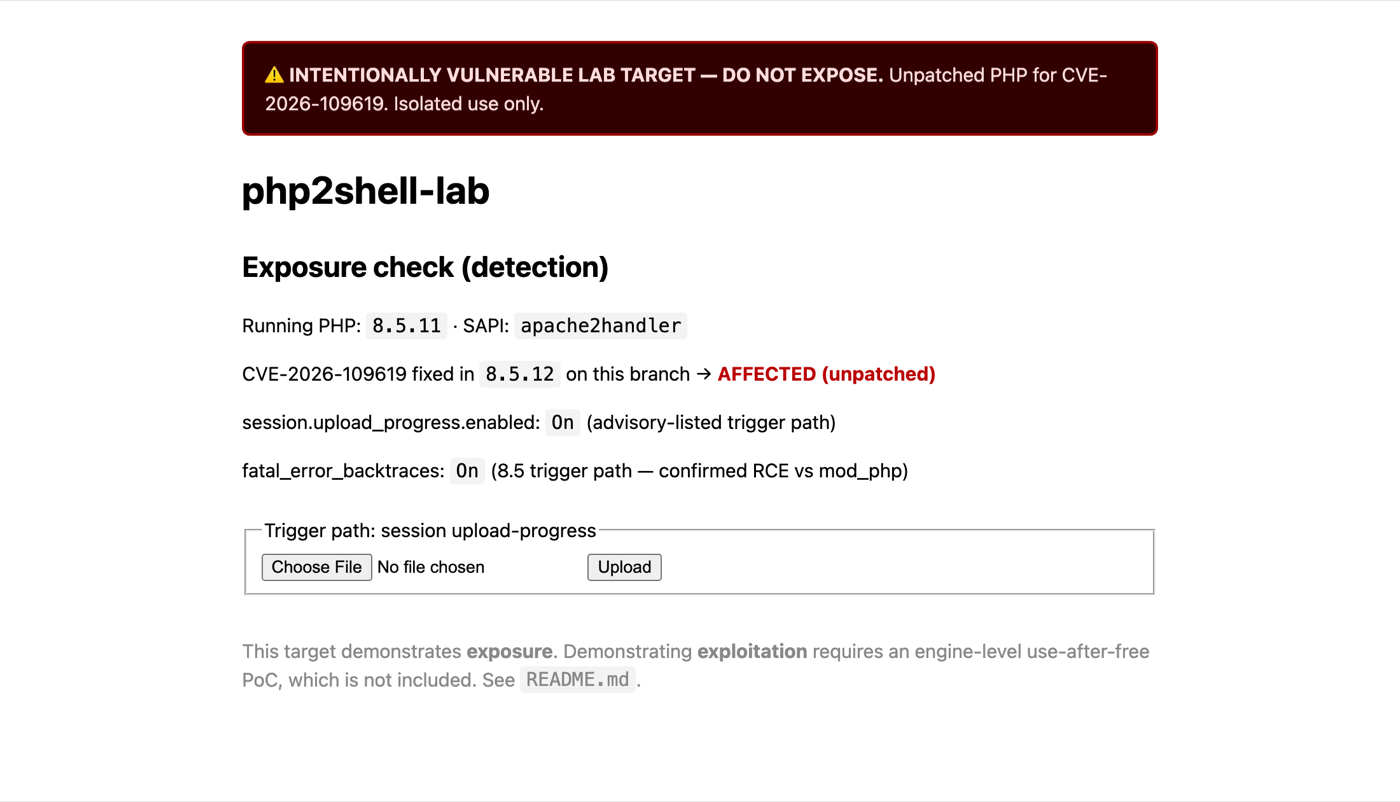
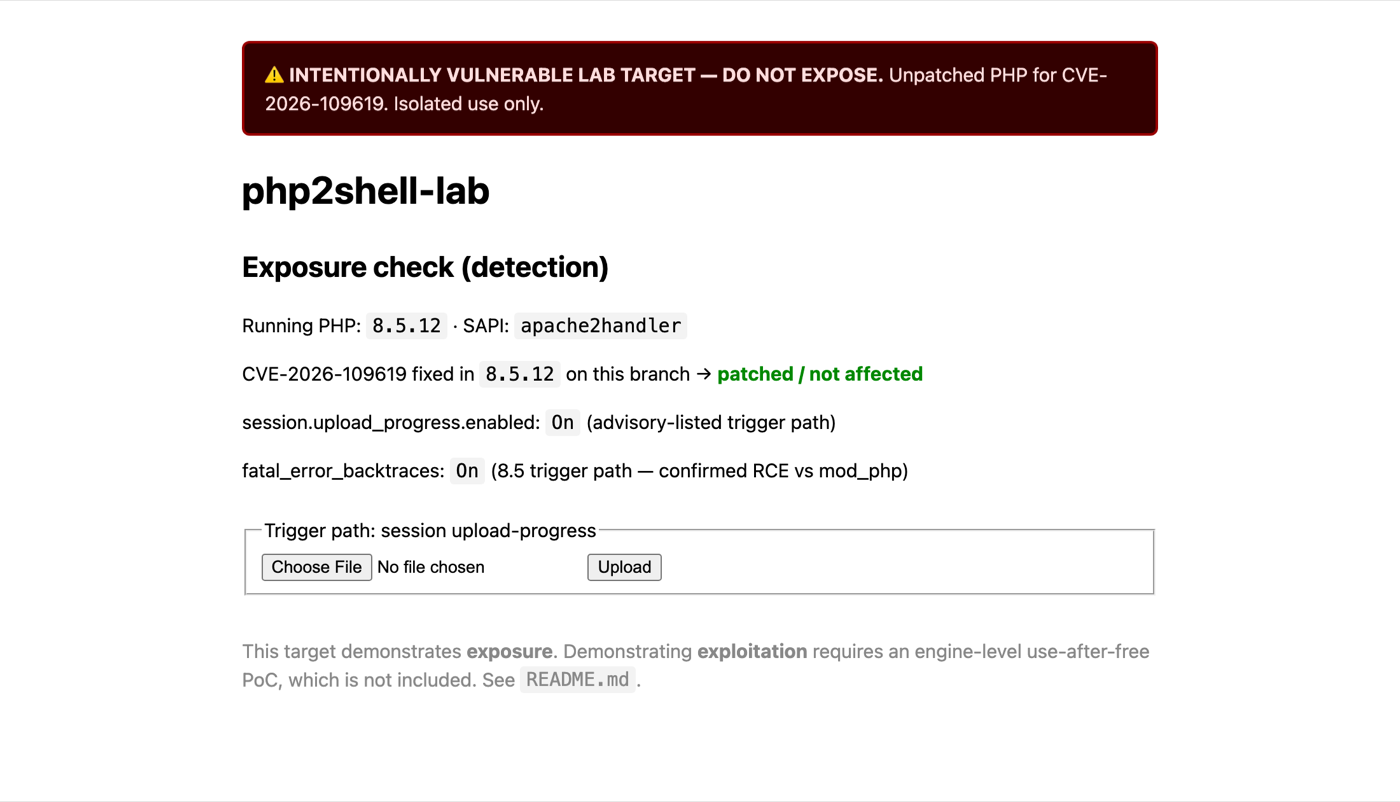
Before PHP 8.5.11: flagged affected.After PHP 8.5.12: same check, now patched.
Three decisions for this week
Authorise an emergency PHP patch window for internet-facing systems first, then internal ones. This is the only real fix.
Ask for a complete PHP inventory, including third-party and vendor-hosted sites. The fleet scanner below produces this list in minutes.
Turn on crash alerting for web servers until patching is done. Repeated PHP crashes are the clearest early warning of an attack.
The rest of this page is written for the team that will carry those out.
Part 2 · Technical deep-dive
Two bugs, one patch
The 22 October 2026 PHP release (8.2.35 / 8.3.36 / 8.4.27 / 8.5.12) fixes two separate, critical memory-corruption flaws in the interpreter. Both reach unauthenticated remote code execution as the web-worker account. NVD scores each 9.8 (CVSS 3.1); PHP's own CNA scores them 9.2 (CVSS 4.0). The two systems disagree on one axis worth noting — NVD rates attack complexity Low, PHP rates it High — which matches the picture below: network-reachable and unauthenticated, but not yet push-button reliable. The 109619 advisory says to follow 109618's remediation as well, and vice versa, because an attack on one tends to touch the other.
The official php.net changelog confirms the shared fix: each release carries one Core entry, "Fixed GHSA-w8hw-w9fx-j79w, GHSA-6wmf-4rv5-p3rp (Avoid state corruption via bailout)." The changelog cites the advisory IDs rather than the CVE numbers; the CVE IDs and scores below come from the advisories themselves.
An out-of-memory abort (longjmp()) fires before request memory is initialised, leaving it invalid for shutdown to read (CWE-416/-824/-755).
109619: stale global state
Persistent SAPIs (mod_php, PHP-FPM) reuse worker processes across requests. Some engine-global state (error, session, object and extension bookkeeping) can still point into the previous request's heap after that request has ended and its memory has been released. If the stale state is touched before request initialisation resets it, the worker dereferences freed memory. That causes memory disclosure at best, and code execution at worst.
109618: OOM corruption
PHP uses longjmp() to abandon a request when it runs out of memory. In some code paths request memory is reachable before its setup finishes; if an allocation fails there, the jump leaves that memory half-built, and request shutdown then reads or branches on it. The demonstrated trigger is forcing an out-of-memory condition during input processing. The full RCE was validated against Apache mod_php, which the advisory notes "unconditionally invokes the request shutdown procedure" even when startup failed; PHP-FPM, FrankenPHP and LSAPI are assessed as likely susceptible but were not demonstrated.
Because both bugs are in the engine, application code is irrelevant to exposure. Exposure depends on the PHP build plus the reachable trigger features, which is why the lab has no "vulnerable app". It runs an unpatched engine with the trigger settings on.
PHP 8.5 only. Code execution confirmed against mod_php.
109619
INI diagnostics before request init
Listed in the advisory, narrower in practice.
109618
Multipart upload with no usable declared length
Passes the up-front post_max_size check, then keeps feeding decoded data.
109618
Input that is cheap on the wire, costly to decode
Many headers per part, empty file controls (don't count toward max_file_uploads), deeply nested field names.
The two bugs do not share a detection
They share the exposure check (same fixed versions) and the crash signal (both are memory corruption). But their attack preconditions differ: 109619 is groomed by a burst of upload-progress fields, 109618 by malformed or amplifying input that forces an out-of-memory abort. Each needs its own network rule, below.
Detection in four layers
There's no fixed exploit byte signature for a memory-corruption race, so these detections focus on exposure (what can be hit), preconditions (what an attacker must do to set it up) and side effects (what a failing exploit leaves behind).
Layer 1 · Exposure
Fleet scanner
Remote PHP version fingerprint, checked against the fixed builds. Answers "where are we exposed?"
Layer 2 · Posture
Host check
Runs on the server itself. Reports version and both CVEs' trigger settings, and tells "mitigated" apart from "patched".
Layer 3 · Network
Suricata rules
Flag setup patterns for both bugs: upload-progress bursts, OOM-inducing input and 500 storms.
Layer 4 · Logs
SIEM queries
Worker segfaults, the highest-fidelity signal, correlated with the network patterns.
Layer 1: Fleet exposure scanner
scan_fleet.py is a Python 3 script with only standard-library dependencies. It reads the PHP version from X-Powered-By, falls back to Server and then the HTML body, and classifies each host as AFFECTED, EOL, PATCHED or UNKNOWN. Exit codes are designed for CI or a scheduled job.
Hardened servers set expose_php=Off and hide the version. Those hosts come back UNKNOWN, not clean. Follow up with Layer 2 or your package inventory. Evidence: scan-before.csv · scan-after.csv.
Layer 2: Host posture check
check_mitigations.sh runs on the PHP host and reads the live version and INI settings from php itself. It reports the 109619 toggles (session.upload_progress.enabled, fatal_error_backtraces) and the 109618 surface (memory_limit, post_max_size, and the input/nesting/upload caps), and warns against capping memory with RLIMIT_AS/RLIMIT_DATA — which itself triggers 109618.
The exit code tracks the patch status plus the 109619 toggles, which are clean on/off settings. 109618 has no single safe value, so its settings are advisory and don't change the code.
Exit
Meaning
0
Patched
1
Affected, with 109619 trigger paths still enabled. Prints the interim settings to change.
3
Affected but mitigated. 109619 paths are off, but the host still needs upgrading.
2
php not found in PATH
Layer 3: Network rules (Suricata)
php2shell.rules holds eight heuristic rules in the local SID range 1026001–1026008: one for 109619, five for 109618's input-amplification paths, a crude oversized-body rule, and a shared crash signal. Treat them as tunable starting points, not turnkey IOCs. SID 1026003 in particular will fire on any noisy app until you baseline it.
SID
CVE
Detects
Default threshold
1026001
109619
Burst of POSTs carrying PHP_SESSION_UPLOAD_PROGRESS (grooming)
Chunked multipart/form-data (slips past the post_max_size pre-check)
1 / src / 60s
1026005
109618
Multipart part with 50+ headers
1 / src / 60s
1026006
109618
40+ empty file controls in one request
1 / src / 60s
1026007
109618
16+ levels of nested field name, multipart body
1 / src / 60s
1026008
109618
16+ levels of nested field name, urlencoded body
1 / src / 60s
1026003
both
HTTP 500 storm from a PHP host (crash side effect)
20 / dst / 10s
The 109618 rules target the advisory's real trigger: input that is small on the wire but expensive for PHP to decode. An attack can stay well under any byte-size threshold, so a size rule alone (1026002) misses it; these catch the shape instead.
View the 109619 and representative 109618 rules
alert http any any -> $HOME_NET any ( \
    msg:"PHP2SHELL CVE-2026-109619 upload_progress field burst (possible UAF grooming)"; \
    flow:to_server,established; http.method; content:"POST"; \
    http.request_body; content:"PHP_SESSION_UPLOAD_PROGRESS"; nocase; \
    threshold:type both, track by_src, count 30, seconds 10; \
    classtype:attempted-admin; sid:1026001; rev:2; )

# 109618: multipart part carrying an abnormal number of headers
alert http any any -> $HOME_NET any ( \
    msg:"PHP2SHELL CVE-2026-109618 multipart part header flood"; \
    flow:to_server,established; http.method; content:"POST"; \
    http.content_type; content:"multipart/form-data"; nocase; \
    http.request_body; content:"Content-Disposition"; nocase; \
    pcre:"/(?:\r\n[A-Za-z0-9-]{1,64}:[^\r\n]{0,256}){50}/"; \
    threshold:type limit, track by_src, count 1, seconds 60; \
    classtype:attempted-admin; sid:1026005; rev:1; )

# Shared crash signal (both CVEs)
alert http $HOME_NET any -> any any ( \
    msg:"PHP2SHELL possible exploitation side effect: HTTP 500 burst from PHP host"; \
    flow:to_client,established; http.stat_code; content:"500"; \
    threshold:type both, track by_dst, count 20, seconds 10; \
    classtype:web-application-attack; sid:1026003; rev:2; )
The full eight-rule set is in php2shell.rules. On an internet-facing sensor, scope the inbound rules to $EXTERNAL_NET any -> $HOME_NET.
Layer 4: Log and SIEM detections
Network rules show attempts. Logs show consequences. A healthy PHP fleet almost never segfaults a worker, so a spike in segfaults is the strongest single indicator. Full query set: log_detections.md.
# mod_php (Apache error_log)
grep -E "child pid [0-9]+ exit signal Segmentation fault \(11\)" /var/log/apache2/error.log

# PHP-FPM
grep -E "child [0-9]+ (exited on signal 11|SIGSEGV)" /var/log/php*-fpm.log

# Splunk-style: segfaults per host per minute
index=web ("exit signal Segmentation fault" OR "exited on signal 11")
| bin _time span=1m | stats count by host, _time
| where count > 3
The page-worthy alert is a correlation
An attempt signal (upload-progress burst, OOM-fatal burst, or any of SID 1026001–1026008) plus a crash signal (worker segfault) from the same host within 5 minutes. That pairing is very unlikely to be benign.
How we validated it
Every artifact on this page was run, not just written. All testing took place in an isolated Docker lab bound to 127.0.0.1 on an internal network.
Artifact
Test
Result
Suricata rules
Loaded with suricata -T on Suricata 7.0.11
Pass All 8 load cleanly
Suricata rules
Replayed against real captured mod_php traffic (Apache 8.4.26 on the live lab): upload-progress burst, 9 MB POSTs, chunked multipart, a 60-header part, 120 empty file controls, 20-level nested names (multipart and urlencoded), genuine HTTP 500s, plus two benign control posts. Capture verified at 0 dropped packets.
Pass All 8 SIDs fire once each. Both controls stay quiet.
scan_fleet.py
Run against the live mod_php lab (real X-Powered-By): unpatched 8.4.26 / 8.5.11, then patched 8.4.27 / 8.5.12. Mock hosts additionally cover EOL (8.1), hidden version and unreachable.
Run inside the live containers (8.5.11 and patched 8.4.27) plus official images for the remaining exit paths
Pass Reports both CVEs' settings. Exit codes 1, 0, 1 and 3 as documented
Lab targets
Real unpatched 8.4.26 and 8.5.11 (mod_php) upgraded to 8.4.27 and 8.5.12
Pass Exposure page and scanner both flip from AFFECTED to patched
The raw output
Not a slide that says "Pass" — the actual console output from those runs.
Fleet scanner — the same command before and after the patch, against the live lab:
$ python3 scan_fleet.py http://127.0.0.1:8080 http://127.0.0.1:8085
http://127.0.0.1:8080   8.4.26    ❌ AFFECTED  (fixed in 8.4.27)
http://127.0.0.1:8085   8.5.11    ❌ AFFECTED  (fixed in 8.5.12)
Summary: 2 affected/EOL, 0 errors, 0 patched.          → exit 1

# ...after upgrading both hosts to the fixed builds...
http://127.0.0.1:8080   8.4.27    ✅ PATCHED  (fixed in 8.4.27)
http://127.0.0.1:8085   8.5.12    ✅ PATCHED  (fixed in 8.5.12)
Summary: 0 affected/EOL, 0 errors, 2 patched.          → exit 0
Suricata — all eight rules on a 103 MB capture of real mod_php traffic (0 packets dropped by the kernel):
$ suricata -r lab-real.pcap -S php2shell.rules \
    --set vars.address-groups.HOME_NET=[172.16.0.0/12]
  1  [1:1026001]  CVE-2026-109619  upload_progress field burst
  1  [1:1026002]  CVE-2026-109618  repeated oversized POST (crude OOM)
  1  [1:1026004]  CVE-2026-109618  chunked multipart
  1  [1:1026005]  CVE-2026-109618  multipart part header flood
  1  [1:1026006]  CVE-2026-109618  multipart empty file-control flood
  1  [1:1026007]  CVE-2026-109618  deeply nested multipart field name
  1  [1:1026008]  CVE-2026-109618  deeply nested urlencoded field name
  1  [1:1026003]  (both)           HTTP 500 burst — real mod_php 500s
→ 8 / 8 rules fired, once each.   Benign control requests: 0 alerts.
Host posture check — run inside the live 8.5.11 container:
$ docker exec php2shell-85 bash check_mitigations.sh
CVE-2026-109618 / 109619 mitigation check
  PHP version : 8.5.11
  Fixed in    : 8.5.12  ->  AFFECTED ❌
  session.upload_progress.enabled : On
  fatal_error_backtraces          : On
  memory_limit : 128M   post_max_size : 8M   max_input_nesting_level : 64
→ exit 1
All of this reproduces from the repo: docker compose up, then the three commands above.
Walkthrough: the lab scanned as exposed, the eight Suricata rules firing on real mod_php traffic (127.0.0.1), the on-host posture check, the fix, and the clean re-scan. Every panel is real output from the lab.
Remediation
Upgrade to 8.2.35, 8.3.36, 8.4.27 or 8.5.12 (or later). This single update fixes both CVEs and is the only complete fix.
If you can't patch yet (109619), set session.upload_progress.enabled=0, and on 8.5 also set fatal_error_backtraces=0. Then restart every worker: the settings only apply to new workers.
If you can't patch yet (109618), the advisory's primary (still incomplete) config mitigation is memory_limit=-1; also keep post_max_size tight and cap max_input_vars, max_input_nesting_level and max_file_uploads. Do not cap process memory with RLIMIT_AS/RLIMIT_DATA — that makes allocations fail and triggers the very bug.
Verify: check_mitigations.sh should exit 0 on each host, the fleet scan should exit 0, and segfault counts should return to baseline. All interim steps reduce exposure but don't remove it.
Retire PHP ≤ 8.1. There is no full upstream fix for those branches.
Scope and limitations
No exploit is published here, on purpose. The lab demonstrates exposure and patch verification, which is the deliverable defenders need.
The network rules are heuristics. They catch setup patterns and side effects, not the corruption itself. Tune thresholds to your traffic.
Version fingerprinting can't see hosts with expose_php=Off, and some vendors backport fixes without changing the version string. Confirm with the vendor's package changelog.
The 109618 rules are tuned to Suricata 7's PCRE step limit; widening their repetition bounds can make them silently stop matching, so retest after any change (the rule file notes where).
Version and advisory data come from the two php-src advisories (109619, 109618) and were cross-checked against the php.net changelog (22 Oct 2026 releases). Re-check php.net for any later point releases before acting on it.
CVSS scores are as published: NVD's CVSS 3.1 9.8 is the primary score (109618, 109619); PHP's CVSS 4.0 9.2 is the secondary score from its advisories.